Knee, shoulder, ankle and tendon pain are rarely one problem with one answer. Injections can help, but the right one depends on what is actually causing your pain. At The Wright Practice, we start with the diagnosis and then match the treatment to it. This guide explains how corticosteroid, PRP and Arthrosamid injections differ, so you know what to ask.

The right injection depends first on the diagnosis, then on how long you have had symptoms and what you have already tried. A swollen, inflamed joint, a sore tendon and a worn knee each respond differently.
That is why our musculoskeletal medicine service begins with a proper examination, and sometimes imaging, before any injection is suggested. Our joint injection treatments page lists the options we offer.
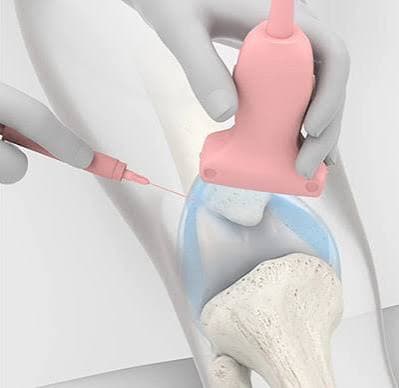
The table below is a general guide. Your own recommendation will depend on your assessment.
| Injection | Best known for | What to expect | Main cautions |
|---|---|---|---|
Corticosteroid | Inflamed joints and bursae, frozen shoulder, trigger finger, arthritis flares | Often quick relief, but evidence suggests the benefit may last only weeks to a few months | Repeated doses can weaken tissue. Can raise blood sugar and blood pressure briefly |
Ultrasound guidance | Tendons, bursae and small joints where accuracy matters | Not a drug, but a way of placing one precisely | Adds time to the appointment. Does not change the choice of medicine |
PRP (platelet rich plasma) | Tennis elbow, Achilles, patellar and other tendon problems, selected joints | Slower, over weeks to months. Results vary and research is mixed | Some soreness afterwards. Not suitable with bleeding disorders or blood thinners |
Arthrosamid | Knee osteoarthritis | A gel that integrates into the joint lining, aiming for longer relief | Knee only. Not suitable for every knee. Evidence is still developing |
A corticosteroid injection reduces inflammation, so it can ease pain in conditions such as bursitis, frozen shoulder, trigger finger and arthritis flares. Relief can come within days.
The honest picture is that benefit often lasts weeks to a few months, and repeated injections are limited by possible effects on cartilage and tendon. For this reason, we use them selectively and not as a routine. Temporary side effects can include a flare of pain, flushing, and a short rise in blood sugar or blood pressure.
You can read more on our page about corticosteroid injections.
PRP may help some tendon problems, such as tennis elbow, Achilles tendinopathy and patellar tendinopathy, but the research is mixed. PRP is made by spinning a sample of your own blood to concentrate platelets, which carry growth factors (natural chemical signals involved in repair).
Results build over weeks, not days, and methods vary between clinics, which makes studies hard to compare. For knee osteoarthritis, UK guidance does not recommend PRP routinely. We therefore discuss it as an option worth considering for selected patients, not a guaranteed fix.
Our platelet rich plasma treatment page explains the procedure in more detail.
| Attribute | Steroid Injection | Hyaluronic Acid | Arthrosamid |
|---|---|---|---|
Mechanism | Reduces inflammation | Adds lubrication | Supports synovial lining |
Typical duration | Weeks to a few months | A few months | Reported benefit up to 1 to 2 years or more |
Repeat frequency | As needed, limited use | Often repeated | Single injection, occasionally repeated |
Best suited to | cute flare-ups | Mild to moderate OA | Persistent symptoms despite other treatment |
Arthrosamid is an injection for knee osteoarthritis that may suit people who have not had enough relief from other treatments and want to delay or avoid surgery. It is a gel that becomes part of the joint lining, which is why it is intended to last longer than a steroid.
It is for the knee only, and evidence is still developing. Our guide to how Arthrosamid works for knee osteoarthritis covers who it may suit.
Injections work best alongside physiotherapy and exercise. We aim to use the least invasive option likely to give meaningful improvement.

Any injection carries a small risk of infection, bruising and a temporary flare of pain. Each medicine has its own cautions, set out above. Seek urgent help if you develop increasing redness, heat, swelling or fever after an injection.

The cost depends on the injection recommended and whether ultrasound guidance is used. This is confirmed after your assessment. Book a consultation for a tailored quote.
A corticosteroid injection reduces inflammation and can ease pain quickly, while PRP uses concentrated platelets from your own blood and aims to support tissue healing over time. PRP tends to act more slowly. Which suits you depends on the diagnosis, how long you have had symptoms and what you have already tried.
It varies. For many joints, studies suggest a clear benefit for a few weeks and sometimes a few months, and the effect usually fades. Repeated injections into the same area are generally limited because of possible effects on cartilage and tendon.
Tendons need more caution than joints. Injecting steroid directly into or around a tendon may weaken it in some cases, and for tennis elbow, research suggests early relief can be followed by worse results later. Your doctor will weigh this up and may favour rehabilitation or another option.
Some people with tendon problems, such as tennis elbow or Achilles tendinopathy, report good improvement after PRP, but trial results are mixed. Products and methods also differ. We explain this openly at The Wright Practice so you can decide with realistic expectations.
Ultrasound lets the doctor see the structure on screen and place the injection precisely. It is particularly useful for tendons, bursae and small joints, where a few millimetres matter. It improves accuracy rather than guaranteeing a result.
Arthrosamid is used for knee osteoarthritis. It is not a general joint injection, so other joints and tendons are usually managed in different ways. Our blog on Arthrosamid explains who it may suit.
No. None of the common injections reverses osteoarthritis. They aim to reduce pain and improve movement, ideally alongside exercise and rehabilitation. That is why we treat injections as part of a wider plan.
Injections may not help if the pain comes from the spine, a nerve or a problem that needs surgery or a different diagnosis. They may also be unsuitable if you have an infection, a bleeding disorder or take blood thinners. A proper assessment comes first.
Sometimes, if the diagnosis is clear and you are suitable, but this is not always advisable. Your doctor may first want imaging, blood tests or a trial of rehabilitation. We will explain the reasoning rather than rush you into a procedure.
You can book a consultation online or contact the team through the website. Appointments take place at 101 Harley Street in London, where the doctor will examine you and discuss your options.
The best injection is the one matched to your diagnosis. Book a consultation with The Wright Practice to find out which, if any, suits your problem.




Rated ★ ★ ★ ★ ★ from 197 Reviews