
Knee osteoarthritis is one of the most common causes of chronic pain and reduced mobility in adults.
Osteoarthritis is a degenerative joint condition in which the cartilage cushioning the ends of bones within a joint breaks down over time. In the knee, this leads to pain, stiffness, swelling and reduced range of movement. It’s particularly common in adults over 50 and in those with a history of joint injury or repetitive physical stress.
As cartilage thins, the joint space narrows and the bones may begin to rub against each other, causing the characteristic pain of osteoarthritis and, in more advanced cases, joint deformity and significant functional impairment.
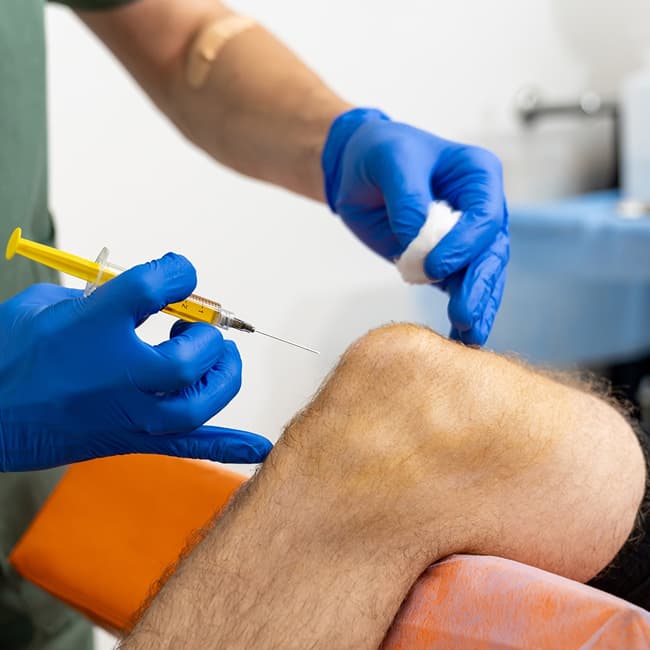
Arthrosamid is a non-biodegradable hydrogel injection designed for patients with knee osteoarthritis. Unlike corticosteroid injections, which primarily reduce inflammation, Arthrosamid becomes integrated within the synovial lining of the knee joint and may provide longer-lasting symptom relief. It is particularly attractive for patients seeking a non-surgical option for managing knee arthritis.
Arthrosamid is an injectable hydrogel, a stable, non-degradable material made of 2.5% polyacrylamide in 97.5% water. When injected into the knee joint, it integrates into the synovial membrane (the joint lining) and provides lasting cushioning and lubrication. Unlike hyaluronic acid injections, which break down within weeks, Arthrosamid is designed to remain stable within the joint for years.
| Treatment | Mechanism | Typical duration | Onset |
|---|---|---|---|
| Corticosteroid | Reduces inflammation within the joint | Weeks to a few months | Fast |
| Hyaluronic acid | Supplements natural joint lubricating fluid | Weeks to months (broken down by the body) | Gradual |
| Arthrosamid | Stable hydrogel integrates into joint lining for lasting cushioning | Up to 5 years (clinical evidence) | Gradual, full benefit over 2-3 months |

Arthrosamid has been studied with follow-up data at one, three, four to five, and ten years. At one year, pain scores were reduced by around 25%, with 62% of patients experiencing clinically meaningful pain relief. At three years, ongoing reductions in pain and stiffness, improved physical function and good tolerability were maintained. At four to five years, the benefit remained sustained with a consistent safety profile, and a ten-year safety study showed very few reported adverse effects. These findings make Arthrosamid one of the most durable non-surgical options currently available for knee osteoarthritis.
The injection is performed by Dr Dan Wright under ultrasound guidance, to ensure precise placement within the joint. Local anaesthetic is given beforehand, and the whole procedure takes approximately 30 minutes. Most patients can resume normal light activity immediately, though strenuous exercise is best avoided for a few days while the gel settles.

Arthrosamid contains no animal proteins and carries a low risk of allergic reaction. The ten-year safety data shows a very good safety profile with no unusual adverse effects, though as with any intra-articular injection there is a small risk of local infection, minimised by strict sterile technique. Arthrosamid is most appropriate for adults with mild to moderate knee osteoarthritis who haven’t responded adequately to conservative treatments such as physiotherapy, activity modification, and oral pain relief; it’s less suitable for very advanced osteoarthritis, where surgical intervention is a more appropriate next step.

Arthrosamid is most appropriate for adults with mild to moderate knee osteoarthritis who have not responded adequately to conservative treatments such as physiotherapy, activity modification, and oral pain relief. It is less suitable for patients with very advanced OA where surgical intervention is a more appropriate next step. Dr Dan will assess your imaging, clinical history, and functional status at consultation to confirm suitability.



Dr Dan takes a thorough approach to knee pain management, starting with a full assessment of the joint, your history, and your functional goals. Arthrosamid is one option within a broader set of interventions available at the practice, including corticosteroid injections and referral to orthopaedic surgeons where surgery is the more appropriate path. The recommendation will always be the one most likely to benefit you.
Wow! Dr. Dan was extremely knowledgeable and attentive to my health and well being. I’m so glad to have found him!

I have been going to Dr Wright for a number of years now. He is highly knowledgeable, compassionate, open minded and efficient, I couldn’t recommend him highly enough
I have been a patient of Doctor Dan for some time and continue to consult with him despite having left the UK. Dan has the enthusiasm and energy of a young man, whilst taking the holistic “physician” approach of an old school family doctor, equipped with the most modern insights and technology.
Dr Jain was great. Expert knowledge with practical advice
Corticosteroid injections reduce inflammation quickly and effectively but typically last weeks to a few months. Arthrosamid provides mechanical cushioning and lubrication within the joint; its effects are more gradual in onset but far longer-lasting, with clinical evidence of benefit at up to five years.
Hyaluronic acid injections supplement the natural lubricating fluid in the joint but are broken down by the body over weeks to months. Arthrosamid is a stable, non-degradable hydrogel that integrates into the joint lining and is not broken down.
Yes. Arthrosamid can be given after previous corticosteroid treatment. Dr Dan will review your history and confirm appropriate timing.
Arthrosamid is not a replacement for surgery in patients with very advanced osteoarthritis or significant structural damage. It is most effective for mild to moderate osteoarthritis and may delay the need for surgery or reduce symptoms to a manageable level for a number of years.
Local anaesthetic is administered before the injection, so most patients experience only mild discomfort during the procedure.
Light activity can be resumed the same day. Strenuous exercise is best avoided for a few days while the hydrogel settles within the joint.
The published clinical data shows benefit extending for up to five years from a single injection. Whether repeat treatment is appropriate will depend on your individual response.
Arthrosamid is not routinely available on the NHS at this time. It is available through private clinics including The Wright Practice.
Please call +44 (0)207 139 1833 or email info@thewrightpractice.com for current pricing, as this is confirmed individually.
The injection procedure, including ultrasound guidance and local anaesthetic, takes approximately 30 minutes in total.
Book a consultation | Call: +44 (0)207 139 1833 | Email: info@thewrightpractice.com
101 Harley Street, London, W1G 6AH
Rated ★ ★ ★ ★ ★ from 197 Reviews